

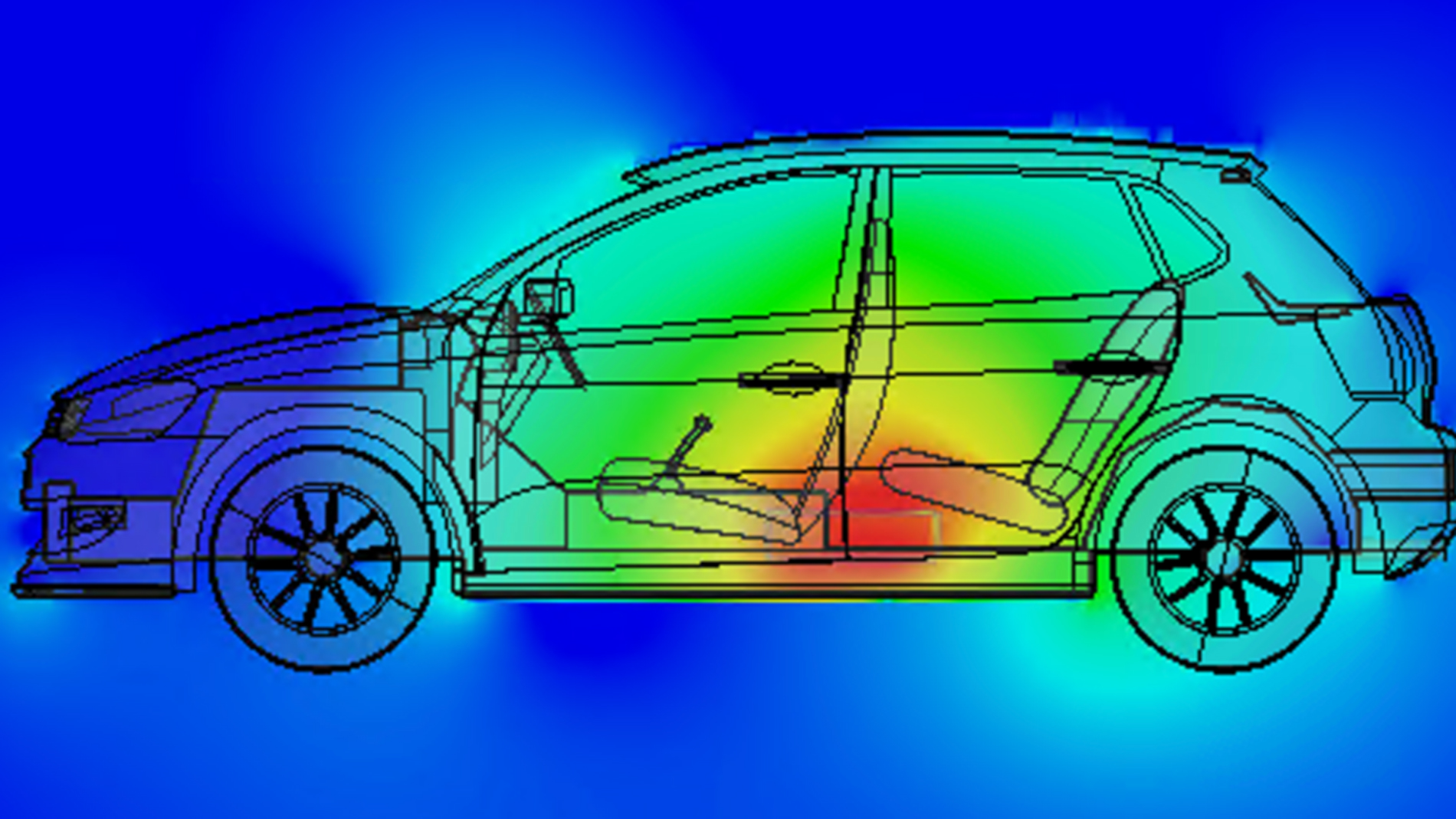
Using a practical application example, the whitepaper explains how the surface equivalence principle can be applied to generate simulation-ready source models from measurement data. It also addresses measurement system requirements, near-field-to-far-field transformations, and the analysis of electromagnetic coupling effects.
The presented methodology enables a realistic assessment of electromagnetic emissions and interactions at early stages of the development process, supporting more efficient EMC analysis and system optimization.
Chapter overview
- Introduction: The growing importance of near-field analysis in EMC engineering
- Equivalent near-field sources and the surface equivalence principle
- Measurement requirements for phase-coherent near-field scanning
- Simulation and near-field measurement of a DC-DC converter
- Co-simulation of circuit and electromagnetic field behavior
- Comparison of measurement and simulation results
- Near-field-to-far-field transformation
- Analysis of electromagnetic interactions with electronic systems
- Integration of measured near-field sources into complex simulation environments
- Summary and outlook
This paper is only available in German.
Author
Dominik Schröder,
Fraunhofer ENAS, Germany
Dominik Schröder studied Electrical Engineering at the University of Paderborn and completed his Master's degree in 2016. Since 2011, he has been part of Fraunhofer ENAS, initially working on wireless power transfer technologies. Since 2017, he has served as a research scientist focusing on EMC near-field scanning and simulation techniques. His research activities concentrate on the measurement and modeling of electromagnetic interference sources and the advancement of near-field analysis methodologies. Simulationsmethoden. Aktuell promoviert er auf dem Gebiet des elektromagnetischen Nahfeldscannings.
Further links:
To the EMV Expo 2027
To the EMV Workshops 2027
Note: More paper are included in the official EMV 2026 Proceedings.